Research

Research interests rooted in machine learning, accessibility, and engineering systems.

My research work aims to connect technical depth with practical usefulness, especially where intelligent systems can improve human outcomes.

Research map

Publications, ongoing investigations, and technical writing collected with more structure.

Filter by type and year
Counts surface active research areas
Visual cards keep the page from feeling flat

Conference

5

2026 5th International Conference on Electrical, Computer & Telecommunication Engineering (ICECTE)

2026Conference

CyberBiLSTM: A Bidirectional LSTM Architecture for Cybersecurity via High-Precision SQL Injection Attack Detection

This work introduces CyberBiLSTM, a deep learning model trained on a newly aggregated and diverse dataset of over 244,112 SQL injection queries. The model achieved a test accuracy of 98.43% and a precision of 99.79%, outperforming five benchmark classifiers. In particular, these results were obtained in just 15 epochs, demonstrating rapid convergence and strong generalization. The dataset’s diversity—sourced from seven public repositories and one proprietary corpus—enabled the model to learn complex adversarial patterns beyond simple token-level features. Comparative evaluations and ROC/confusion matrix analyses confirm CyberBiLSTM’s superiority in both precision and robustness. This foundation sets the stage for real-world deployment and future extensions, including explainability, zero-day attack detection, and integration into developer-facing security tools.

Application securityBenchmark testingBiLSTMBidirectional long short term memoryCybersecurityPayloadsPrevention and mitigationRobustnessSQL injectionScalabilitySemanticsService-oriented architecture
Open publication

2026 5th International Conference on Electrical, Computer & Telecommunication Engineering (ICECTE)

2026Conference

CNN-Transformer Fusion Network for Multi-Class Leaf Disease Classification

The current study relied on a curated subset of 24 classes with high image counts, which may limit the model’s immediate applicability to rarer botanical pathologies or imbalanced field data. Furthermore, while the model excels in controlled datasets, practical deployment faces "in-the-wild" constraints such as variable lighting, complex backgrounds, and overlapping foliage, which can obscure local disease features. From a hardware perspective, the 16.23 million parameters, though optimized, present a potential computational bottleneck for low-end mobile devices or offline diagnostic tools in remote agricultural zones.

Computer architectureComputer visionContext modelingConvolutional neural networksDeep learningDiseasesFace recognitionFeature extractionPrecision agricultureTransformers
Open publication

Recognition

Research-adjacent milestones, awards, and project highlights.

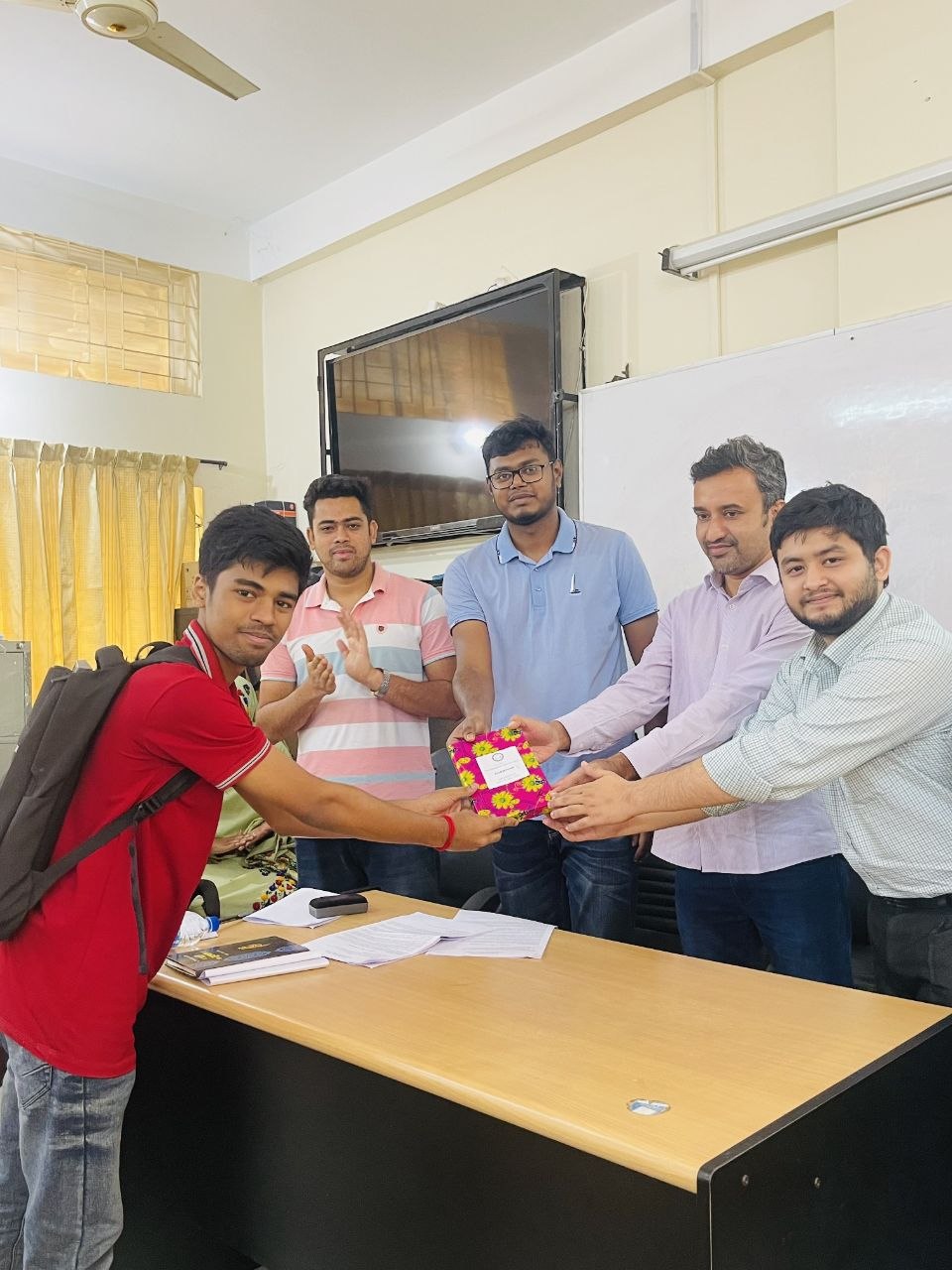
Champion at Programming Contest 2k22

Programming Contest Organised by DEpartment of ETE for 20 Series

2022

Champion at Programming Contest 2k22

Achievement details coming soon.

C/C++LabProblem SolvingProgramming