Research

Research interests rooted in machine learning, accessibility, and engineering systems.

My research work aims to connect technical depth with practical usefulness, especially where intelligent systems can improve human outcomes.

Research map

Publications, ongoing investigations, and technical writing collected with more structure.

Filter by type and year
Counts surface active research areas
Visual cards keep the page from feeling flat

Conference

5

2025 International Conference on Quantum Photonics, Artificial Intelligence, and Networking (QPAIN)

2025Conference

Real-Time Detection and Translation of Bangla Sign Language Characters Using Deep Learning

This study demonstrates the effectiveness of Google Teachable Machine in developing an accessible and accurate Bangla Sign Language recognition system. The system's reliability is evident in its nearflawless classification across all character categories, with minimal errors occurring only between visually similar signs. Implementation as a web application through the Flask framework enhances real-world utility by offering immediate translation via camera input, visual confirmation of recognised signs, and integrated learning resources. This combination of features addresses critical needs for both communication assistance and language education within the Bangla-speaking deaf community. The solution proves that assistive technology can maintain high accuracy standards while remaining broadly accessible, particularly important for underrepresented languages where complex systems often face adoption challenges.

Assistive technologiesAuditory systemBangla Sign Character DetectionCVzoneData augmentationDeep LearningDeep learningFlask Web ApplicationInclusive CommunicationMediaPipeOpenCVReal-Time TranslationReal-time systemsSign languageTeachable MachineTranslationVisualization
Open publication

2024 27th International Conference on Computer and Information Technology (ICCIT)

2024Conference

Residual Block-Driven CNN for Accurate White Blood Cell Image Analysis and Classification

Our findings show that using residual blocks is a very effective approach for detecting and classifying white blood cells (WBCs). As residual block offers lossless data restoration, We built a custom CNN model with residual blocks and achieved an accuracy of around 97.65%. We also tested our dataset (Raabin-WBC [4]) on other models that use depthwise separable convolutions, like MobileNet, InceptionNet, and XceptionNet. After fine-tuning, these models achieved accuracies of 97.85%, 98.40%, and 98%, respectively.

Convolutional neural networksFeature extractionMedical diagnosisOrganismsProtectionResidual neural networksWhite blood cells
Open publication

2026 5th International Conference on Electrical, Computer & Telecommunication Engineering (ICECTE)

2026Conference

CyberBiLSTM: A Bidirectional LSTM Architecture for Cybersecurity via High-Precision SQL Injection Attack Detection

This work introduces CyberBiLSTM, a deep learning model trained on a newly aggregated and diverse dataset of over 244,112 SQL injection queries. The model achieved a test accuracy of 98.43% and a precision of 99.79%, outperforming five benchmark classifiers. In particular, these results were obtained in just 15 epochs, demonstrating rapid convergence and strong generalization. The dataset’s diversity—sourced from seven public repositories and one proprietary corpus—enabled the model to learn complex adversarial patterns beyond simple token-level features. Comparative evaluations and ROC/confusion matrix analyses confirm CyberBiLSTM’s superiority in both precision and robustness. This foundation sets the stage for real-world deployment and future extensions, including explainability, zero-day attack detection, and integration into developer-facing security tools.

Application securityBenchmark testingBiLSTMBidirectional long short term memoryCybersecurityPayloadsPrevention and mitigationRobustnessSQL injectionScalabilitySemanticsService-oriented architecture
Open publication

2026 5th International Conference on Electrical, Computer & Telecommunication Engineering (ICECTE)

2026Conference

CNN-Transformer Fusion Network for Multi-Class Leaf Disease Classification

The current study relied on a curated subset of 24 classes with high image counts, which may limit the model’s immediate applicability to rarer botanical pathologies or imbalanced field data. Furthermore, while the model excels in controlled datasets, practical deployment faces "in-the-wild" constraints such as variable lighting, complex backgrounds, and overlapping foliage, which can obscure local disease features. From a hardware perspective, the 16.23 million parameters, though optimized, present a potential computational bottleneck for low-end mobile devices or offline diagnostic tools in remote agricultural zones.

Computer architectureComputer visionContext modelingConvolutional neural networksDeep learningDiseasesFace recognitionFeature extractionPrecision agricultureTransformers
Open publication

2024 27th International Conference on Computer and Information Technology (ICCIT)

2024Conference

A Hybrid Approach for Accurate Brain Tumor Detection Using Deep Learning Techniques

We assessed five widely-used deep learning models—ResNet50, Xception, DenseNet121, VGG19, and VGG16 with custom layers—for detecting brain tumors. We tracked the performance of each model over multiple epochs by analyzing metrics such as accuracy, loss, and ROC curves, ensuring fairness by standardizing hyperparameters and maintaining consistent batch sizes during training.

Brain modelingBrain tumorsComputer visionDeep learningInformation technologyMagnetic resonance imagingResidual neural networksVGG19
Open publication

Recognition

Research-adjacent milestones, awards, and project highlights.

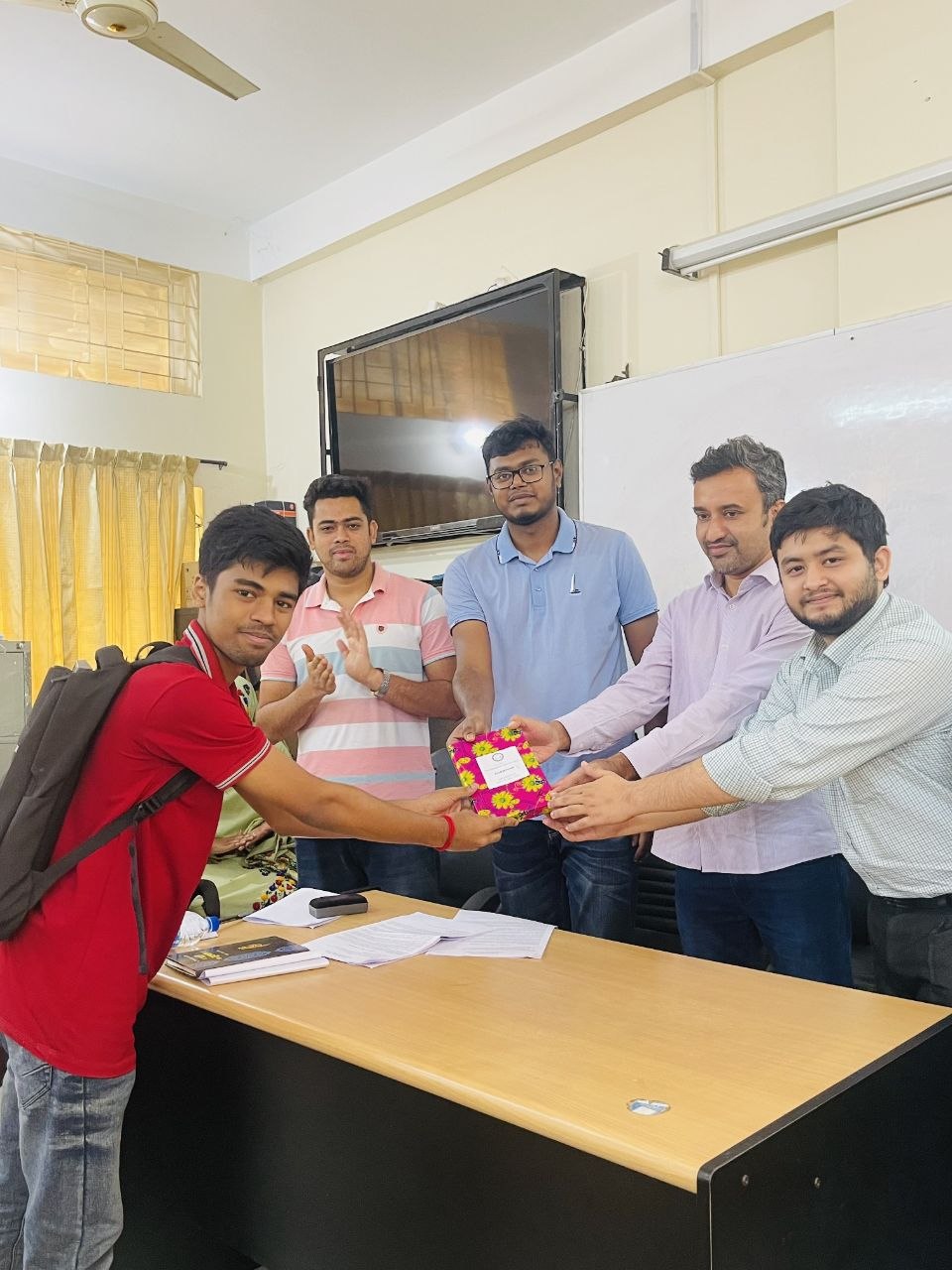
Champion at Programming Contest 2k22

Programming Contest Organised by DEpartment of ETE for 20 Series

2022

Champion at Programming Contest 2k22

Achievement details coming soon.

C/C++LabProblem SolvingProgramming